

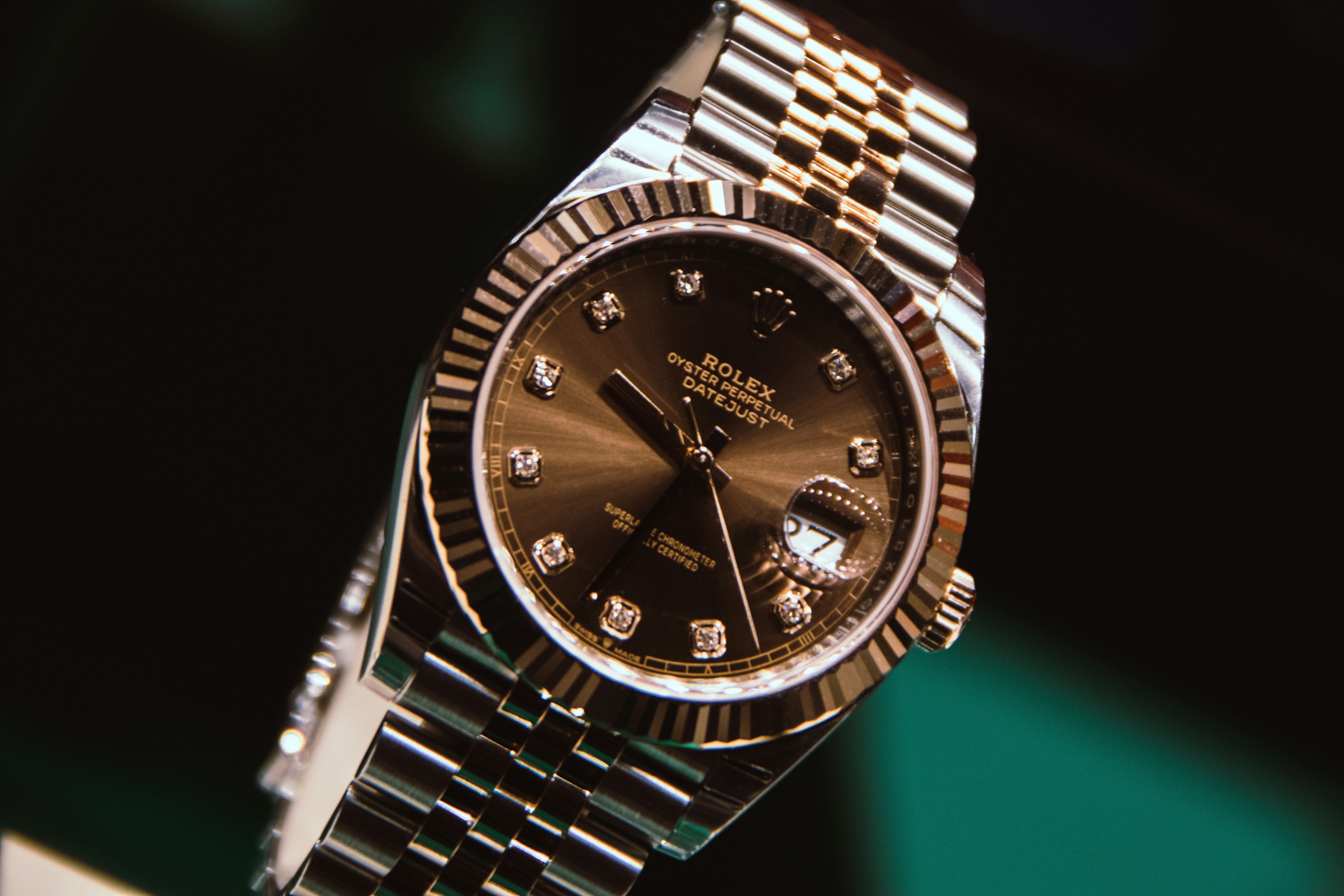
Authentication
6 min read
May 12, 2025
How to Spot a Fake Rolex: Expert Authentication Tips
How to Spot a Fake Rolex: Expert Authentication Tips
Last Updated: December 2025 | Reading Time: 6 minutes
Summary
Counterfeit Rolexes are getting harder to spot—but they're still not perfect. This guide breaks down the key authentication markers that separate genuine Rolex watches from high-quality fakes, including weight, movement sound, engravings, serial numbers, and cyclops magnification. You'll learn what to inspect before buying a pre-owned Rolex, why professional authentication matters, and when to walk away. Whether you're buying your first Rolex or your tenth, these expert tips will help you avoid costly mistakes.
The fake Rolex in front of me looked perfect.
Solid weight. Clean dial. Smooth bezel action. The seller was confident, the price was "too good to pass up," and the buyer—a first-time Rolex purchaser—was ready to hand over R85,000.
Then I flipped it over.
The caseback engraving was slightly off-center. The serial number font looked just a bit too thin. And when I opened the case? A Chinese automatic movement where a Swiss chronometer should have been.
The watch was fake. And the buyer almost lost R85,000.
This happens more often than you'd think. Counterfeit Rolexes have become so sophisticated that even experienced collectors occasionally get fooled. The difference between a R120,000 genuine Submariner and a R3,000 fake can come down to details most people never check.
After 73 years of authenticating Swiss-made watches, I've learned this: you don't need to be a watchmaker to spot most fakes. You just need to know what to look for.
Why This Matters More Than Ever
Here's the uncomfortable truth: fake Rolexes are everywhere.
Online marketplaces. Facebook groups. Even some brick-and-mortar stores that don't know (or don't care) what they're selling.
And they're not just fooling first-time buyers anymore.
Modern "super fakes" can pass casual inspection. They use real sapphire crystals. Solid steel cases. Automatic movements that tick smoothly. Some even replicate serial numbers from genuine Rolex watches.
But here's what separates a R120,000 investment from an R85,000 mistake: knowing which details counterfeiters can't replicate perfectly.
The 7 Authentication Markers That Matter Most
1. Weight: The First Red Flag Most People Miss
Pick up a genuine Rolex Submariner. It's heavy. Really heavy.
Now pick up a fake. It feels... lighter. Cheaper. Like the difference between a premium watch and a department store knockoff.
Why?
Rolex uses 904L stainless steel (or 18k gold, or platinum). These materials have significant heft. Counterfeiters typically use cheaper 316L steel or alloys that weigh 10-20% less.
What to do:
If you've ever held a genuine Rolex, you'll feel the difference immediately. If you haven't, compare the watch you're considering to the manufacturer's published weight specs. A Submariner should weigh approximately 155 grams with bracelet. If it feels noticeably lighter, that's your first warning sign.
Nuance: Some high-end fakes now use correct materials. Weight alone isn't definitive—but it's your first checkpoint.
2. Movement Sound: What You Should (and Shouldn't) Hear
Hold a Rolex to your ear. What do you hear?
Genuine Rolex: Near silence. Maybe the faintest high-pitched hum. Rolex uses a smooth sweeping second hand powered by an automatic mechanical movement.
Fake Rolex: Often a noticeable ticking sound. Many counterfeits use cheaper quartz movements or low-quality automatic movements that don't operate as smoothly.
The "sweep test":
Watch the second hand. A genuine Rolex sweeps smoothly around the dial at 8 beats per second (28,800 vibrations per hour). It looks like continuous motion.
A fake? The second hand often "stutters" or ticks in visible increments—especially visible if you record it on your phone in slow motion.
Actionable takeaway: If you hear loud ticking or see the second hand jumping instead of sweeping, walk away.
3. Cyclops Magnification: The 2.5x Test That Reveals Almost Everything
Look at the date window on a Rolex with a cyclops lens (that bubble over the date).
Genuine Rolex: The date is magnified 2.5 times. It should be large, crisp, and nearly fill the cyclops bubble.
Fake Rolex: Magnification is often 1.5x or less. The date looks small inside the bubble, with visible space around it.
This is one of the easiest tells because counterfeiters struggle to replicate Rolex's precise cyclops specifications.
What to look for:
Is the date large and centered?
Does it nearly touch the edges of the cyclops bubble?
Is the magnification crisp and clear (not blurry)?
If the answer to any of these is "no," you're likely looking at a fake.
4. Engravings: Where Counterfeiters Consistently Fail
Rolex engraving is perfect. Not "pretty good." Perfect.
What to inspect:
Rehaut (inner bezel) engraving:
Starting around 2005, Rolex began engraving the serial number and "ROLEX ROLEX ROLEX" around the rehaut (the ring between the dial and crystal). On genuine watches, this engraving is microscopic, perfectly spaced, and laser-precise.
On fakes? The engraving is often too large, poorly spaced, or uses incorrect font.
Caseback:
Here's something most people don't know: Rolex almost never engraves the caseback. If you see "Rolex," "Oyster," "Perpetual," or any decorative engraving on the caseback, it's fake.
The only exceptions are some vintage models (pre-1970s) and limited editions—but even then, the engraving is extremely minimal.
Serial and model numbers:
Found between the lugs (you need to remove the bracelet to see them). Genuine Rolex numbers are deeply engraved and sharp. Fakes are often shallow, uneven, or use incorrect fonts.
Actionable takeaway: Use a jeweler's loupe or macro lens on your phone to inspect engravings. If they look "off," trust your instinct.
5. Dial and Printing Quality: The Details That Matter
Rolex dials are flawless.
What genuine Rolex dials have:
Perfectly aligned hour markers
Crisp, sharp text with no bleeding or smudging
Applied indices (raised markers, not printed) that catch light beautifully
Lume plots (glow material) that are evenly filled
What fake Rolex dials often have:
Misaligned text or markers (look at the "6" marker—is it centered?)
Blurry or smudged printing
Flat printed markers instead of applied indices
Uneven or missing lume
The "SWISS MADE" test:
At the bottom of the dial, it should read "SWISS MADE" or "SWISS" (older models). The spacing, font, and alignment should be perfect. Fakes often get this wrong.
Actionable takeaway: Study high-resolution photos of genuine Rolex dials for your specific model. Compare every detail—text size, spacing, marker alignment. Even a 1mm misalignment is a red flag.
6. Crown and Winding Feel: What Smooth Really Means
Unscrew the crown (the winding knob) and wind the watch.
Genuine Rolex:
Smooth, precise threading when unscrewing
Buttery smooth winding action with no grinding
Distinct clicks when winding (you'll feel them)
Crown logo is deeply engraved and sharp
Fake Rolex:
Rough or loose threading
Grinding or catching when winding
Shallow or poorly defined crown logo
The triplock test:
Many Rolex models use a triplock crown (three dots under the crown logo). When you unscrew it, it should extend noticeably from the case. Fakes often use a twin-lock or have no functional locking system at all.
7. Serial and Model Number Verification
Every Rolex has a unique serial number (between the lugs at 6 o'clock) and a model/reference number (between the lugs at 12 o'clock).
What to do:
Remove the bracelet to expose the numbers
Photograph them clearly
Cross-reference the serial number with Rolex production records (available online)
Verify the model number matches the watch's features
Red flags:
Serial number doesn't match production year for that model
Model number doesn't exist in Rolex's catalog
Numbers are shallow, uneven, or use incorrect font
Serial number appears on multiple watches (counterfeiters often reuse serials)
Nuance: Some counterfeiters now use real serial numbers stolen from genuine watches. This is why serial verification alone isn't enough—you need to check everything.
What to Do Before You Buy
Never buy a pre-owned Rolex without doing these three things:
1. Demand clear, high-resolution photos
Ask for photos of:
Full watch (front and back)
Serial and model numbers (between the lugs)
Rehaut engraving
Movement (if the seller can open the case)
Date window (to check cyclops magnification)
2. Get it authenticated by a professional
If you're spending R50,000+, spend R500-R1,500 for professional authentication. We offer authentication services, as do most reputable watch dealers.
3. Buy from reputable sources
Authorized Rolex dealers (new watches)
Established pre-owned watch dealers with guarantees
Auction houses with authentication guarantees
Avoid: Facebook Marketplace, Gumtree sellers with no history, "too good to be true" prices
When to Walk Away (No Matter What the Seller Says)
Some red flags are absolute deal-breakers:
Walk away if:
Seller refuses to provide serial numbers
Price is 30%+ below market value with no explanation
Seller can't or won't let you verify authenticity
Watch has an engraved caseback (with rare exceptions)
Seller pressures you to "buy now before someone else does"
You feel any hesitation or discomfort
Trust your instinct. If something feels wrong, it probably is.
The One Thing Most Buyers Get Wrong
Here's the mistake I see constantly:
Buyers focus on price instead of authenticity.
"It's such a good deal!" they say. "The seller seems honest!"
But here's the reality: there are no bargains in the Rolex market. If a Submariner typically sells for R120,000 and someone's offering one for R75,000, there's a reason.
Either it's:
Fake
Stolen
Heavily damaged
Or the seller doesn't know what they have (rare, but possible)
Actionable takeaway: If the price seems too good, assume it's fake until proven otherwise. Get it authenticated before spending a cent.
What to Do Right Now
You've just learned the key authentication markers that separate genuine Rolexes from counterfeits.
If you're considering buying a Rolex:
Use this checklist before committing to any purchase. Don't skip steps.
If you already own a Rolex and want peace of mind:
Get it authenticated. Even if you bought it from a "reputable" source, verification ensures you're protected.
If you're unsure about a watch you're considering:
Send us clear photos. We'll provide a preliminary assessment and let you know if professional authentication is recommended.
Need Your Rolex Authenticated?
We've been authenticating Swiss-made luxury watches in South Africa since 1951. Our authentication service includes:
Full inspection of movement, case, dial, and serial numbers
Verification against Rolex production records
Written authentication certificate
Same-day service available for Johannesburg/Sandton/Pretoria
Get your Rolex authenticated today.
Request Authentication Service →
Or reach out directly:
WhatsApp: 078 603 8717
Email: jhbjewelersandwatchmakers@gmail.com
Key Takeaways
Weight is your first checkpoint—genuine Rolexes are significantly heavier than most fakes.
Cyclops magnification reveals most counterfeits—the date should nearly fill the bubble at 2.5x magnification.
Rolex almost never engraves casebacks—if you see decorative engraving, it's likely fake.
Movement sound matters—genuine Rolexes are nearly silent with smooth sweeping seconds.
Serial numbers can be verified—but don't rely on them alone since counterfeiters steal real serials.
Professional authentication is worth it—spending R500-R1,500 can save you from an R85,000 mistake.
About the Author
This guide was written by the team at JHB Jewellers & Watchmakers, South Africa's most trusted buyers of Swiss-made luxury watches since 1951. We've authenticated thousands of Rolex watches across Johannesburg, Pretoria, and Sandton—and we believe every buyer deserves to know they're getting the genuine article.


Ready to Get Your Free Valuation Today?
No obligation. No pressure. Just a fair offer backed by 7+ decades of trusted service.