

Valuation Guides
8 min read
Apr 12, 2025
How Much Is My Rolex Worth? A South African Valuation Guide
Summary
Most Rolex owners don't know what their watch is actually worth—and dealers profit from that confusion. This guide breaks down the 5 key factors that determine your Rolex's value in the South African market: model/reference number, condition, documentation, market demand, and service history. You'll learn how to research comparable sales, spot lowball offers, and understand why dealer offers typically range from 60-75% of market value. Whether you're settling an estate, need liquidity, or are simply curious, this guide gives you the knowledge to avoid leaving money on the table.
Here's something most Rolex owners don't realize until it's too late:
I've watched this happen more times than I can count. A client walks into a dealer in Sandton, gets offered what sounds like a reasonable number, accepts it, and only later discovers they left R50,000+ on the table.
The truth? Most people have no idea what their Rolex is actually worth—and the industry profits from that confusion.
After 73 years of buying Swiss-made luxury watches in South Africa, I've learned something crucial: knowing your Rolex's true market value isn't just about getting a better price. It's about not being taken advantage of during a vulnerable moment.
Whether you're settling an estate, need liquidity, or are simply curious, this guide will show you exactly how to determine what your Rolex is worth in today's South African market—and why dealer offers vary so wildly.
Why This Matters More Than You Think
Let me tell you about a call I received last year.
A woman in Pretoria had inherited her father's 1985 Rolex Datejust. A local dealer offered her R35,000. She was ready to accept—until her son suggested she get a second opinion.
When she came to us, we showed her recent comparable sales. Same model, similar condition. They were selling for R65,000-R72,000 on Chrono24 and at auction.
The dealer's offer? 51% of true market value.
This isn't a scam story. That dealer wasn't breaking laws. They were simply offering what worked in their favor, banking on the fact that most sellers don't know how to research value themselves.
And here's the thing: you don't have to be that seller.
The 5 Factors That Actually Determine Your Rolex's Value
Forget everything you've heard about "Rolex holds its value." That's only half true. Some Rolexes appreciate. Others depreciate by 40% the moment you walk out of the boutique.
Here's what actually matters:
1. Model and Reference Number
Not all Rolexes are created equal.
A Rolex Oyster Perpetual Date from the 1980s? You're looking at R25,000-R45,000 depending on condition.
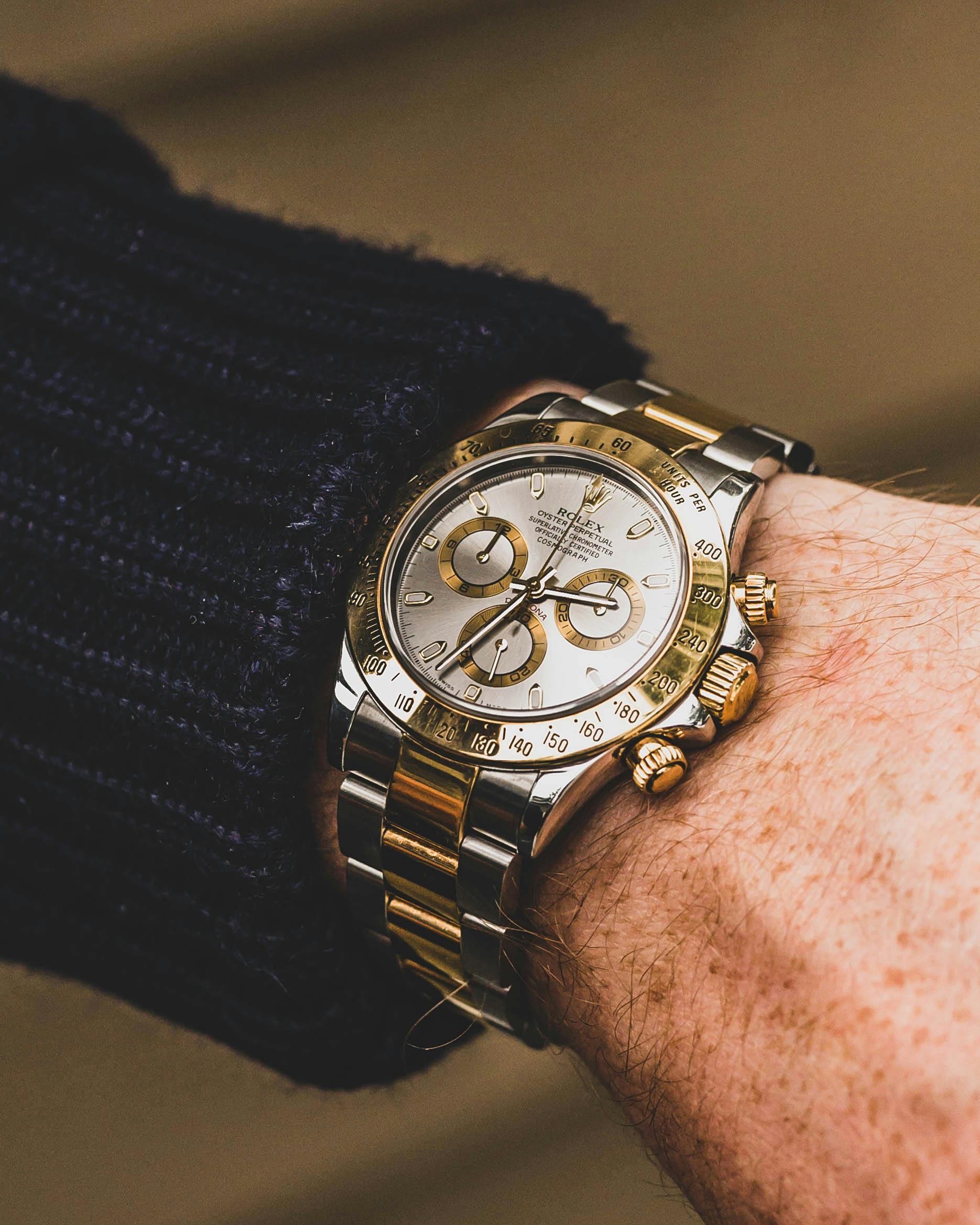
A Rolex Daytona "Paul Newman" from the same era? Try R1.2 million to R4 million+.
Why the massive difference?
Demand. Rarity. Cultural cachet. The Daytona has been worn by celebrities, featured in films, and hyped by collectors for decades. The Oyster Perpetual Date? It's a beautifully made watch, but it doesn't have the same collector fever.
What you need to know:
Submariner, GMT-Master II, Daytona, and Datejust tend to hold value best
Older references (pre-2000s) with "tropical dials" or rare features can command premiums
Women's models and two-tone pieces generally depreciate faster (with exceptions like the Lady-Datejust in good condition)
Actionable takeaway: Find your watch's reference number (it's engraved on the case between the lugs at 12 o'clock). Search "[Reference Number] sold prices South Africa" or check Chrono24's sold listings. This gives you a baseline.
2. Condition: The R30,000 Difference Between "Good" and "Excellent"
I've seen two identical Rolex Submariners—same year, same reference—sell for R95,000 and R125,000 respectively.
The difference? Condition.
Here's the grading system dealers and collectors actually use:
Mint / Unworn
No signs of wear
Original protective stickers still on
Never sized or adjusted
Commands 90-100% of retail (sometimes more for discontinued models)
Excellent
Minor hairline scratches on clasp
Case edges still sharp
Dial and hands pristine
This is where most well-kept watches sit
Good
Visible scratches on case and bracelet
Some polishing wear (rounded edges)
Dial intact but may show aging
Still perfectly wearable and functional
Fair / Poor
Heavy scratches, dings, or dents
Significant polishing that's altered case shape
Dial damage, moisture spots, or fading
Value drops 30-50% compared to excellent condition
Here's what most people get wrong: They think polishing increases value. It doesn't.
Over-polishing removes metal, softens edges, and reduces collector appeal. An unpolished Submariner with honest wear is often worth more than a heavily polished one.
Actionable takeaway: Be honest about condition when getting valuations. Overstating it wastes everyone's time. Understating it means you might accept a lowball offer. Take clear photos in natural light showing all wear.
3. Documentation: Box and Papers Aren't Just "Nice to Have"
Let me be blunt: having your original box, papers, warranty card, and receipt can increase your Rolex's value by 10-30%.
Why?
Provenance. Authentication. Collector confidence.
A Rolex Datejust with full box and papers tells a story. It proves the watch is what the seller claims. It shows care. And for collectors buying online (which is most transactions now), it reduces risk.
Without papers, buyers wonder:
Is this watch stolen?
Is it authentic?
Has it been serviced properly?
What's the true age?
Those doubts cost you money.
Here's the hierarchy of value (from most to least valuable):
Full set: Watch + original box + papers + warranty card + receipt + service records
Box and papers: Watch + box + warranty card
Papers only: Watch + warranty card (helps with authentication)
Watch only: Just the watch, no documentation
Real example: In 2024, a Rolex GMT-Master II Ref. 126710BLRO with full box and papers sold on Chrono24 for R187,000. Same model, similar condition, no papers? R162,000. That's a R25,000 difference.
Actionable takeaway: If you have papers but lost the box, that's fine—the warranty card is what really matters. If you genuinely don't have any documentation, be upfront. We can still authenticate using serial numbers and movement inspection, but expect a lower offer.
4. Market Demand: Why Your Dad's Datejust Isn't Worth What He Paid
This is where sellers get emotional.
"But my father bought this for R18,000 in 1995! Inflation alone means it should be worth R60,000 now!"
Except it's not.
Market value isn't about what you paid, or what you think it should be worth. It's about what buyers are willing to pay today.
And demand shifts.
Models currently in high demand in South Africa (2025):
Rolex Submariner (any year, but especially "Hulk" green dial and newer ceramic models)
Rolex Daytona (steel models especially—waitlists are 5+ years)
Rolex GMT-Master II ("Pepsi" and "Batman" bezels)
Vintage Rolex Explorer I and II (1960s-1980s)
Models with softer demand:
Two-tone Datejust (unless rare dial or vintage)
Rolex Oyster Perpetual Date (34mm, older references)
Rolex Air-King (pre-2016 models)
Here's the nuance most people miss: Demand in South Africa lags global trends by 6-12 months. When a model gets hot in the U.S. or Europe, we see the same spike here eventually—but not immediately. If you're selling, timing matters.
Actionable takeaway: Check Chrono24 sold listings for your exact model in the past 90 days. Sort by "South Africa" or "Rand." If you see 10+ sales in that window, demand is strong. If you see 2-3, it's softer. Adjust your expectations accordingly.
5. Service History: The Detail That Separates Serious Sellers from Casual Ones
Most people don't think about this. But serious collectors and dealers absolutely do.
A Rolex service from an authorized service center costs R8,000-R15,000. It includes:
Complete movement disassembly
Ultrasonic cleaning
Replacement of worn parts
Pressure testing for water resistance
Timing regulation
If your watch has been recently serviced (within 2-3 years), and you have documentation, that adds value.
Why? Because the buyer knows they won't need to service it immediately. That's R10,000+ they don't have to spend.
Conversely, if your watch hasn't been serviced in 15 years and is running poorly, expect dealers to deduct service costs from their offer.
Actionable takeaway: If you're planning to sell soon and your watch hasn't been serviced in 10+ years, don't service it yourself. It's expensive, and you won't recoup the full cost. Let the buyer decide. Just be upfront about service history.
How to Research What Your Rolex Is Actually Worth (Step-by-Step)
Forget "free online valuations" that are wildly inaccurate. Here's how to do it properly:
Step 1: Identify Your Exact Model
Find the reference number between the lugs (you'll need to remove the bracelet). Google "[Reference Number] Rolex" to confirm the model name.
Step 2: Check Chrono24 Sold Listings
Go to Chrono24.com, search your reference number, and filter by "Sold Listings." Look at the past 90 days. Note the range—this is your market baseline.
Step 3: Check Local South African Dealers
Search for your model on local platforms (Gumtree, Facebook Marketplace, pre-owned watch dealers). South African pricing can be 10-15% different from global pricing due to import taxes and demand.
Step 4: Factor in Your Condition and Documentation
If your watch is "excellent" with full papers, you're at the high end of the range. If it's "good" with no papers, you're at the low end.
Step 5: Understand Dealer vs Private Sale Value
Private sale (selling yourself online): You'll get closer to market value, but it takes time, risk, and effort.
Dealer purchase (selling to a buyer like us): You'll get 60-75% of market value, but it's instant, safe, and requires zero effort.
Why the gap? Dealers need margin to cover overhead, risk, and the time it takes to resell. That's not a rip-off—that's how the secondary market works.
Actionable takeaway: If you're in a hurry, selling to a reputable dealer is your best bet. If you have 2-3 months and want top rand, list it yourself. Just know the risks (scams, fake payments, lowball offers).
Why Dealer Offers Vary So Wildly (And How to Spot a Lowball)
Ever wonder why one dealer offers R70,000 and another offers R95,000 for the same watch?
Here's what's happening:
1. Different business models
Some dealers operate on thin margins with high volume. Others operate on fat margins with slow turnover. The first group offers more. The second group offers less.
2. Current inventory needs
If a dealer already has three Submariners in stock, they don't need yours urgently. Lower offer. If they have a client waiting for your exact model, higher offer.
3. Knowledge gaps
Sadly, some dealers don't know the market well. They'll lowball vintage or rare references because they don't understand their value.
4. Opportunistic tactics
A few dealers (not most, but a few) will intentionally lowball hoping you don't know better. They bank on urgency, emotion, or ignorance.
How to spot a lowball:
Offer is 40%+ below Chrono24 sold prices for similar condition
Dealer refuses to explain how they arrived at the number
Pressure tactics ("This offer expires today")
Vague language ("It's just not worth much right now")
What a fair offer looks like:
Dealer shows you comparable sales data
Offer is 60-75% of current market value (for dealer purchase, not consignment)
Transparent breakdown of how they arrived at the price
No pressure, no rush
Professional documentation
The One Thing Most Sellers Get Wrong (And How to Avoid It)
Here's the mistake I see constantly:
Sellers confuse retail price with resale value.
Your Rolex retails for R180,000 new at an authorized dealer. But the moment you walk out with it, resale value drops to R135,000-R150,000 (depending on model and demand).
Why?
Because buyers can wait 6-18 months and buy new from an authorized dealer. Or they can buy from the secondary market and get it now, but at a discount.
The only exceptions: Rolex Daytona, certain GMT-Master II models, and rare vintage pieces. These actually sell above retail on the secondary market because demand exceeds supply.
For most Rolex models, expect:
0-2 years old: 70-85% of retail
5-10 years old: 60-75% of retail (depending on condition)
15+ years old (vintage): Wildly variable. Some appreciate, most stay flat or depreciate.
Actionable takeaway: If a dealer offers you 65% of what you paid new, that's not a lowball—that's market reality. Adjust expectations accordingly.
What to Do Right Now
You've just learned more about Rolex valuation than 90% of sellers ever will.
Here's your next step:
If you're just curious about value:
Do the Chrono24 research I outlined above. It takes 15 minutes and gives you a solid baseline.
If you're seriously considering selling:
Get 2-3 quotes from reputable buyers. Compare not just the price, but the process, transparency, and professionalism.
If you want a transparent valuation backed by real data:
Submit photos of your Rolex to us. We'll provide a fair market offer within 24 hours, show you the comparable sales we used, and give you zero pressure to accept.
Whether you sell to us, another dealer, or go the private route—you'll now know if you're getting a fair offer.
Ready to Find Out What Your Rolex Is Actually Worth?
We've been buying Rolex and Swiss-made luxury watches in South Africa since 1951. Every valuation we provide includes:
Recent comparable sales data (so you can verify the offer yourself)
Transparent pricing breakdown
Zero obligation—decline and we return your watch fully insured
Same-day EFT payment if you accept
Get your free valuation in 24 hours.
Or reach out directly:
WhatsApp: 078 603 8717
Email: jhbjewelersandwatchmakers@gmail.com
Key Takeaways
Your Rolex's value depends on 5 main factors: Model/reference, condition, documentation, market demand, and service history.
Box and papers can add 10-30% to value—don't underestimate their importance.
Dealer offers of 60-75% of market value aren't lowballs—that's how the secondary market works. Anything below 55% is suspicious.
Research sold prices on Chrono24 (not listing prices) for the most accurate baseline.
Condition matters more than most sellers realize—be honest when describing wear.
Timing affects value—models go in and out of favor. If demand is soft now, waiting 6 months might yield better results.
About the Author
This guide was written by the team at JHB Jewellers & Watchmakers, South Africa's most trusted buyers of Swiss-made luxury watches since 1951. We've valued and purchased thousands of Rolex watches across Johannesburg, Pretoria, Sandton, and beyond—and we believe every seller deserves transparent pricing backed by real market data.

Ready to Get Your Free Valuation Today?
No obligation. No pressure. Just a fair offer backed by 7+ decades of trusted service.